Understanding ETF Premiums and Discounts: A Practical Guide for Investors
As investors increasingly turn to exchange-traded funds (ETFs) for their portfolios, understanding the intricacies of ETF pricing becomes crucial. One key aspect that can significantly impact your returns is the concept of premiums and discounts. This guide will explain what these terms mean, how they affect your investment decisions, and what you can do to mitigate potential risks associated with them.
What Are ETF Premiums and Discounts?
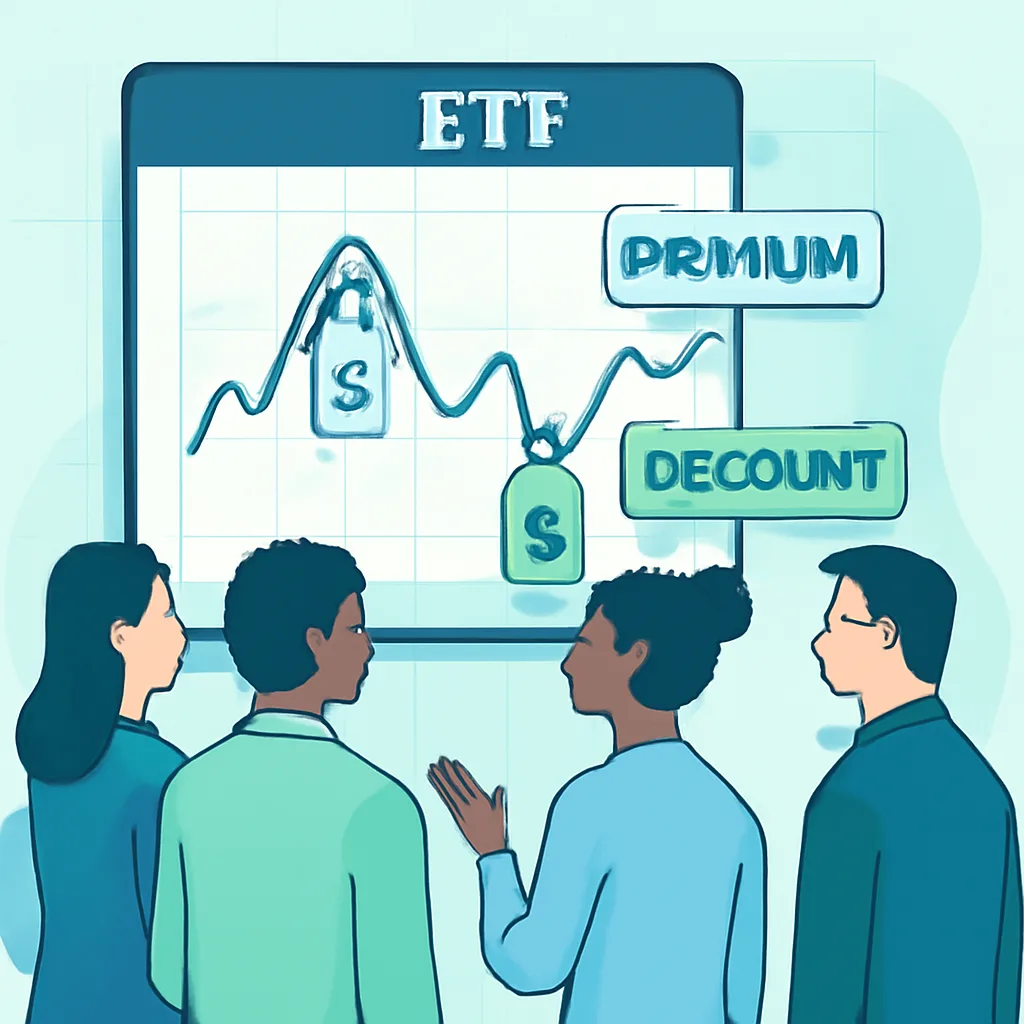
ETFs are designed to track the performance of a specific index or asset class. However, the market price of an ETF can differ from its net asset value (NAV), which is the assessed value of all the underlying securities in the fund. When the market price is higher than the NAV, the ETF is said to be trading at a premium. Conversely, when the market price is lower than the NAV, it is trading at a discount (source 2).
The divergence from NAV occurs due to supply and demand dynamics in the market. Heavy demand can push the price above the NAV, while heavy selling pressure can cause it to dip below the NAV. This phenomenon is particularly relevant for investors who buy and sell shares in the secondary market, as they may end up paying more or receiving less than the fair value of the underlying assets.
Why Do Premiums and Discounts Matter?
The implications of trading at a premium or discount can be substantial. For example, buying an ETF at a significant premium and later selling it at a discount can lead to considerable losses. Therefore, understanding the stability of an ETF's premiums and discounts is more critical than merely looking at their average values. A stable premium might indicate lower transaction costs, while a volatile discount could expose investors to higher risks (source 2).
Example of Premium Stability
Consider two ETFs: ETF A has an average premium of 18 basis points with stable fluctuations, while ETF B has an average premium of 0 basis points but experiences significant volatility. An investor might assume ETF B is the better choice due to its lower average premium. However, ETF A's stability means that transaction costs are likely to be predictably modest, making it a preferable option in the long run (source 2).
Factors Influencing Premiums and Discounts
Several factors can influence the size and stability of premiums and discounts:
- Market Conditions: High volatility in the broader market can lead to more significant discrepancies between an ETF's market price and NAV. During such times, ETFs that invest in international assets or fixed income may experience larger premiums and discounts due to the complexities involved in pricing these securities.
- Asset Class: Different asset classes exhibit varying behaviors regarding premiums and discounts. For instance, domestic equity ETFs generally trade close to their NAVs, while international and fixed-income ETFs may have more pronounced discrepancies due to factors like foreign market hours and pricing inefficiencies (source 2).
- Trading Volume: Higher trading volumes can lead to more accurate pricing, reducing the likelihood of significant premiums or discounts. If an ETF has low trading volume, it may be more susceptible to price discrepancies.
How to Navigate ETF Premiums and Discounts
To mitigate risks associated with premiums and discounts, consider the following strategies:
- Research Historical Data: Look at the historical premiums and discounts of an ETF to assess its stability. A fund with a consistent trading pattern may be a better option than one with erratic price movements.
- Monitor Market Conditions: Be mindful of broader market trends that may affect ETF pricing. Avoid trading during periods of high volatility to minimize the risk of buying at a premium or selling at a discount.
- Utilize Tools and Resources: Platforms like FINRA’s Fund Analyzer can help investors compare the fees and expenses of different ETFs, providing insights into how premiums and discounts may affect their overall returns (source 1).
Key Takeaways
- Understand the Concepts: Grasp the significance of premiums and discounts when investing in ETFs, as they can affect your overall returns.
- Focus on Stability: A stable premium may be preferable to a volatile discount, leading to lower transaction costs.
- Research and Monitor: Use historical data and market conditions to inform your investment decisions and avoid potential pitfalls.
Conclusion
Navigating the complexities of ETF premiums and discounts is essential for any investor looking to optimize their portfolio. By understanding how these factors impact your investments, you can make more informed decisions that enhance your financial outcomes. Keep an eye on stability over mere averages, and utilize available tools to assess your options effectively.
Sources
Source Snapshot
| Source | Main angle | URL |
|---|---|---|
| 1 | Mutual Fund and ETF Fees and Expenses – Investor Bulletin | https://www.investor.gov/introduction-investing/general-resources/news-alerts/alerts-bulletins/investor-bulletins/mutual-fund-and-etf-fees-a |
| 2 | ETF premiums and discounts, explained | https://corporate.vanguard.com/content/corporatesite/us/en/corp/articles/etf-premiums-and-discounts-explained.html |
📰 Sources
This article aggregates 2 sources. Click (source N) inline to jump to the matching entry.
- Mutual Fund and ETF Fees and Expenses – Investor Bulletin www.investor.gov
- ETF premiums and discounts, explained corporate.vanguard.com